
When Is the Right Time to Build Your Social Media Footprint?

Every quarter, small and mid-market business leaders face the same persistent pressure: Should we be doing more on social media?
The answers from conventional marketing agencies are predictable. Some tell you that you started too late and are losing ground to digital-native competitors. Others urge you to launch immediately across every platform, pouring capital into daily posts, trending audio, and algorithmic guesswork. The result is a familiar cycle: businesses either launch too soon with disjointed messaging, delay indefinitely due to resource constraints, or post sporadically without ever finding a sustainable operational rhythm.
When executive leadership evaluates social media through an analytical lens, the core issue becomes obvious: 𝐬𝐨𝐜𝐢𝐚𝐥 𝐦𝐞𝐝𝐢𝐚 𝐢𝐬 𝐚 𝐝𝐲𝐧𝐚𝐦𝐢𝐜, 𝐟𝐥𝐮𝐢𝐝 𝐞𝐜𝐨𝐬𝐲𝐬𝐭𝐞𝐦 𝐰𝐡𝐞𝐫𝐞 𝐚𝐭𝐭𝐞𝐧𝐭𝐢𝐨𝐧, 𝐞𝐧𝐠𝐚𝐠𝐞𝐦𝐞𝐧𝐭, 𝐚𝐧𝐝 𝐚𝐥𝐠𝐨𝐫𝐢𝐭𝐡𝐦𝐢𝐜 𝐫𝐞𝐚𝐜𝐡 𝐚𝐫𝐞 𝐜𝐨𝐧𝐬𝐭𝐚𝐧𝐭𝐥𝐲 𝐬𝐡𝐢𝐟𝐭𝐢𝐧𝐠. Treating social media as a static checklist or a simple volume game fails because it misdiagnoses the fundamental problem. The question isn’t how often you post—it’s whether your organization possesses the structural readiness to post with intent.
The Readiness Matrix: Resource Allocation vs. Strategic Intent
Publishing on social channels before establishing strategic architecture is not agility--it is capital misallocation.
The threshold for market entry is governed by two uncompromising operational prerequisites:
𝐂𝐚𝐩𝐄𝐱 𝐕𝐢𝐚𝐛𝐢𝐥𝐢𝐭𝐲: You have reached an operational steady-state where capital, time, and human talent can be consistently allocated to media production without degrading core service delivery or operational bandwidth.
𝐀𝐫𝐜𝐡𝐢𝐭𝐞𝐜𝐭𝐮𝐫𝐚𝐥 𝐂𝐥𝐚𝐫𝐢𝐭𝐲: You have engineered the exact utility, positioning, and strategic vector of the content prior to producing a single asset.
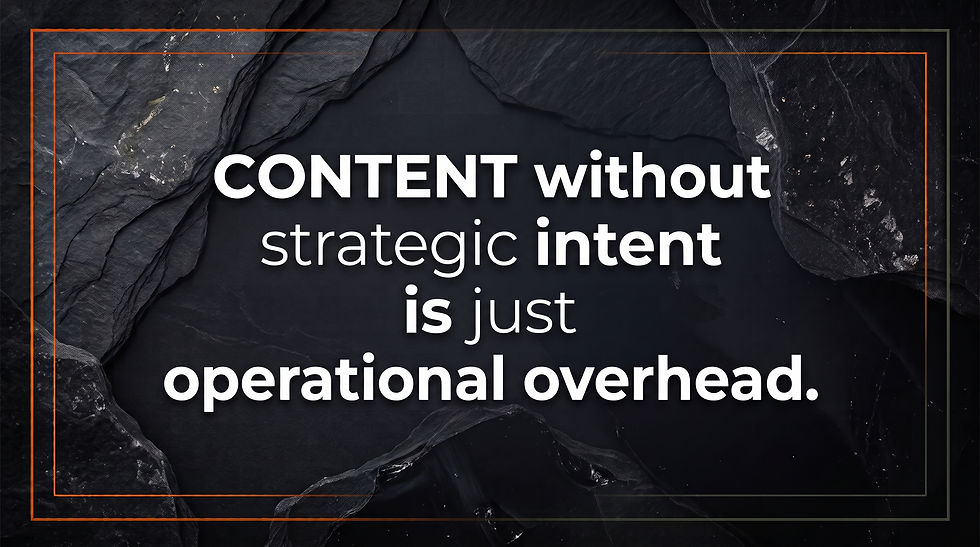
"𝐂𝐨𝐧𝐭𝐞𝐧𝐭 𝐰𝐢𝐭𝐡𝐨𝐮𝐭 𝐬𝐭𝐫𝐚𝐭𝐞𝐠𝐢𝐜 𝐢𝐧𝐭𝐞𝐧𝐭 𝐢𝐬 𝐣𝐮𝐬𝐭 𝐨𝐩𝐞𝐫𝐚𝐭𝐢𝐨𝐧𝐚𝐥 𝐨𝐯𝐞𝐫𝐡𝐞𝐚𝐝."
Launching without this foundation forces your organization to trade executive focus for algorithmic noise. Before committing resources to public-facing channels, leadership must establish three baseline structural parameters:
𝐓𝐚𝐫𝐠𝐞𝐭 𝐀𝐮𝐝𝐢𝐞𝐧𝐜𝐞: 𝘞𝘩𝘰, 𝘱𝘳𝘦𝘤𝘪𝘴𝘦𝘭𝘺, 𝘪𝘴 𝘵𝘩𝘪𝘴 𝘤𝘰𝘯𝘵𝘦𝘯𝘵 𝘦𝘯𝘨𝘪𝘯𝘦𝘦𝘳𝘦𝘥 𝘧𝘰𝘳?
𝐎𝐫𝐠𝐚𝐧𝐢𝐳𝐚𝐭𝐢𝐨𝐧𝐚𝐥 𝐏𝐮𝐫𝐩𝐨𝐬𝐞: 𝘞𝘩𝘢𝘵 𝘦𝘹𝘱𝘭𝘪𝘤𝘪𝘵 𝘣𝘶𝘴𝘪𝘯𝘦𝘴𝘴 𝘰𝘣𝘫𝘦𝘤𝘵𝘪𝘷𝘦 𝘥𝘰𝘦𝘴 𝘵𝘩𝘪𝘴 𝘤𝘩𝘢𝘯𝘯𝘦𝘭 𝘴𝘦𝘳𝘷𝘦—𝘢𝘶𝘵𝘩𝘰𝘳𝘪𝘵𝘺 𝘣𝘶𝘪𝘭𝘥𝘪𝘯𝘨, 𝘥𝘪𝘳𝘦𝘤𝘵 𝘥𝘢𝘵𝘢 𝘢𝘤𝘲𝘶𝘪𝘴𝘪𝘵𝘪𝘰𝘯, 𝘰𝘳 𝘮𝘢𝘳𝘨𝘪𝘯 𝘥𝘦𝘧𝘦𝘯𝘴𝘦?
𝐕𝐚𝐥𝐮𝐞 𝐔𝐭𝐢𝐥𝐢𝐭𝐲: 𝘞𝘩𝘢𝘵 𝘲𝘶𝘢𝘯𝘵𝘪𝘧𝘪𝘢𝘣𝘭𝘦 𝘪𝘯𝘴𝘪𝘨𝘩𝘵 𝘰𝘳 𝘰𝘱𝘦𝘳𝘢𝘵𝘪𝘰𝘯𝘢𝘭 𝘶𝘵𝘪𝘭𝘪𝘵𝘺 𝘥𝘰𝘦𝘴 𝘵𝘩𝘦 𝘳𝘦𝘢𝘥𝘦𝘳 𝘳𝘦𝘤𝘦𝘪𝘷𝘦 𝘪𝘯 𝘦𝘹𝘤𝘩𝘢𝘯𝘨𝘦 𝘧𝘰𝘳 𝘵𝘩𝘦𝘪𝘳 𝘢𝘵𝘵𝘦𝘯𝘵𝘪𝘰𝘯?
If these parameters cannot be defined with mathematical clarity, content creation remains an unhedged operational expense rather than a value-generating asset.
Finding Your Stride
The frustration many executives feel with social media stems from a lack of alignment. When content creation is disconnected from business goals, every post feels like an uphill lift and yields unpredictable results.
"𝐒𝐨𝐜𝐢𝐚𝐥 𝐦𝐞𝐝𝐢𝐚 𝐢𝐬𝐧’𝐭 𝐚 𝐦𝐞𝐠𝐚𝐩𝐡𝐨𝐧𝐞 𝐟𝐨𝐫 𝐞𝐟𝐟𝐨𝐫𝐭. 𝐈𝐭 𝐢𝐬 𝐚 𝐦𝐢𝐫𝐫𝐨𝐫 𝐨𝐟 𝐬𝐲𝐬𝐭𝐞𝐦 𝐝𝐞𝐬𝐢𝐠𝐧."
You will find your stride the exact moment you align four critical vectors:
Brand: The authentic operational truth of who you are and how you execute.
Message: The core insight, thesis, or value proposition you bring to the market.
Purpose: The defined organizational outcome every post is designed to achieve.
Intent: The deliberate value you provide to the end user in exchange for their time.
When these four components operate in sync, social media stops feeling like a distraction and begins functioning as designed: a precise, scalable channel for market intelligence, brand distribution, and customer acquisition.
Diagnostic Self-Test
Before publishing your next asset, complete this sentence in plain text:
"Our target viewer will consume this content because it solves [X] specific problem, driving them toward [Y] clear outcome."
If you cannot define X and Y without relying on marketing fluff, pause--your angle needs refinement before allocating further capacity.
Key Takeaway for Leadership
Do not launch because of platform FOMO, and do not delay out of uncertainty. Evaluate your operational capacity, define your strategic purpose, align your message, and execute only when you can do so with total intentionality.

About the Author
Derek Selfridge is the Chief Executive Officer and Principal Strategist at Strategic Business Consulting (SBC). A veteran, entrepreneur, and systems engineering practitioner, his research focuses on information architecture, operational friction reduction, and regional economic intelligence. He advises mid-market firms, regional enterprises, and leadership teams across Okaloosa County and national growth corridors on replacing executive subjectivity with verified data systems.
Shape Local Market Transparency
Take the lead in creating fair, transparent commercial benchmarks for our community. As a business owner, your ground-level experience with agency pricing, retainers, and reporting metrics holds the key to uncovering local market standards. By contributing to SBC’s independent Okaloosa County Market Study, you directly help build anonymous regional benchmarks that protect cash flow, eliminate hidden risks, and empower local executives to negotiate higher-value contracts.

Scan the code below to share your perspective. It takes less than five minutes, and your contribution directly strengthens your business, equips your fellow owners, and drives real transparency across our regional commerce corridor.
Data-In, Data-Out; Input by business owners like you directly supports our regional research & publications.

Comments